
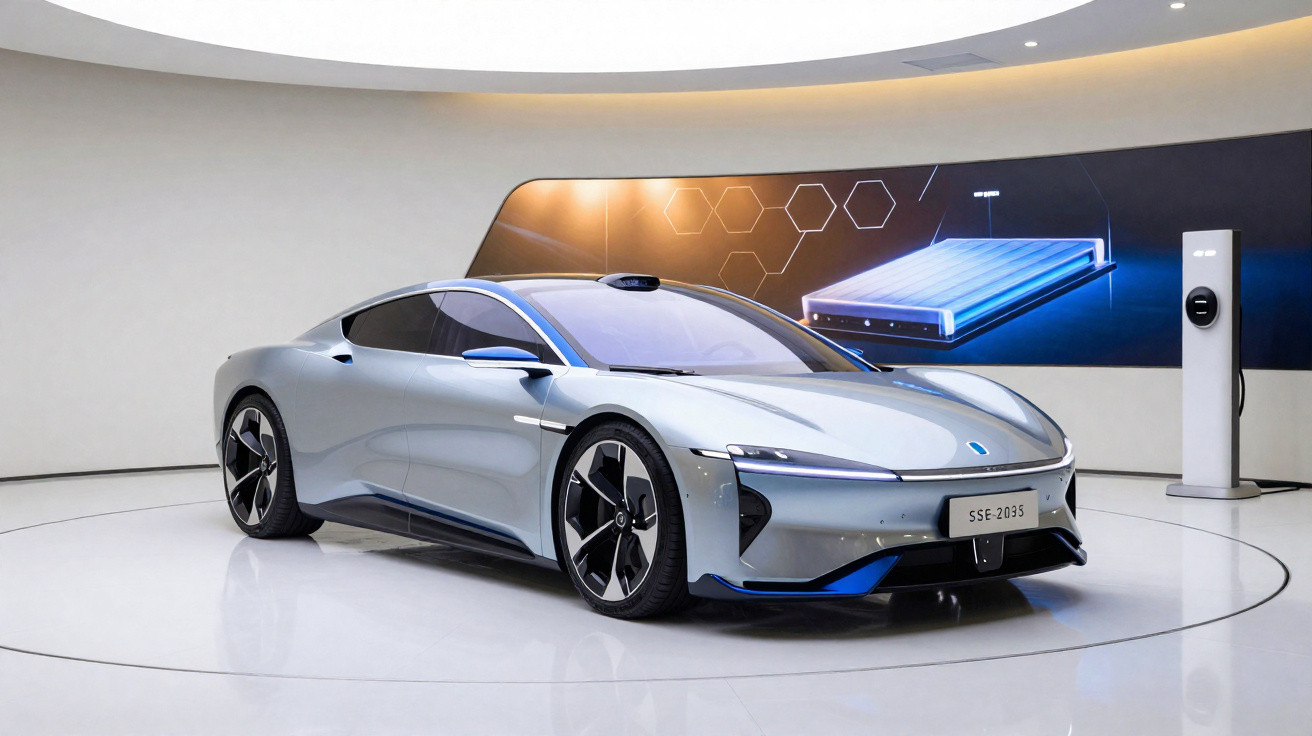
While attention is largely focused on gigafactories and eye-catching electric vehicles, France is discreetly pursuing a much less visible resource: a vital battery material that could determine which nations continue manufacturing cars in ten years’ time.
The overlooked material that could determine the future of EVs
In Rueil-Malmaison, near Paris, a new business named Argylium has begun trading with an ambitious goal: to become Europe’s foremost producer of sulfide solid electrolytes, commonly referred to as SSEs. These materials are central to all-solid-state batteries, which many industry figures regard as the probable successor to current lithium-ion battery packs.
The venture is supported by a powerful partnership. French organisations Axens and IFP Énergies nouvelles are joined by Belgian chemicals specialist Syensqo. Collectively, they contribute ten years of research, a set of patents already tested in laboratories, and engineering teams with extensive experience in battery materials.
France is betting that mastering this single battery component could give it leverage over Europe’s entire electric car value chain.
Argylium does not merely intend to provide laboratories with gram quantities of powder. Its aim is industrial-scale output: tonnes of electrolyte material supplied to European gigafactories before competitors in Asia and North America secure the market.
Why solid electrolytes are important for the cars of tomorrow
Replacing flammable liquids with a solid structure
A conventional lithium-ion battery uses a liquid electrolyte to enable lithium ions to move between its anode and cathode. That liquid is flammable and vulnerable to impacts, overheating and production flaws. Manufacturers must therefore incorporate complicated safety systems and restrict charging speeds.
All-solid-state batteries eliminate the liquid, substituting it with a solid electrolyte. Argylium is concentrating on argyrodites, a group of sulphur compounds. They allow lithium ions to travel rapidly without requiring liquid solvents.
This change could offer electric cars several advantages:
- Less flammable solvent, reducing the risk of a fire caused by the electrolyte itself.
- Greater tolerance of heat and demanding conditions, which eases safety requirements.
- Battery configurations with increased energy density, providing more range at the same weight.
Argylium is targeting cells of around 500 Wh/kg by 2028–2030. Depending on their chemistry and use, many current lithium-ion vehicle batteries are nearer 200–300 Wh/kg. Meeting the company’s target would therefore deliver substantially more stored energy per kilogram, potentially enabling thinner or lighter packs.
The company also says its technology could bring charging times below ten minutes. Reaching that point would significantly alter driver behaviour and place pressure on petrol infrastructure.
An experienced partnership in charge
Argylium has selected two seasoned leaders to oversee the difficult move from laboratory work to factory production. Alessandro Chiovato, a chemist who spent more than 25 years with Solvay and subsequently Syensqo, has become chief executive. His career has long sat at the intersection of strategy, innovation and the battery materials market.
Technical director Valérie Buissette works alongside him, providing scientific continuity. With training in materials science and approximately a decade of specialism in solid-state batteries, she forms a bridge between academic research and industrial performance objectives.
France is trying to turn years of European lab work into hard industrial power, before the window closes.
France’s four-stage strategy to lead sulfide electrolytes
Moving from pilot production to large-scale manufacturing
Argylium has set out a four-phase roadmap intended to establish its European position.
- Phase 1 – Product line and validation: Complete its sulfide solid electrolyte portfolio and conduct qualification programmes with battery manufacturers, using material from pilot plants in Paris and La Rochelle. Meanwhile, a financial consortium is being put together to finance expansion.
- Phase 2 – Raw material security: Secure access to crucial inputs, including lithium sulfide. This includes creating a pilot unit for these precursors and increasing output to several tonnes annually.
- Phase 3 – Demonstration scale: Build an industrial demonstration plant capable of making several hundred tonnes. This phase will prove the manufacturing methods and support the first commercial deliveries, particularly to carmakers.
- Phase 4 – Full industrialisation: Increase capacity to tens of thousands of tonnes a year, while licensing the technology to partners to speed deployment throughout Europe.
The strategy is founded on vertical integration. Argylium intends to manage the chain from lithium hydroxide to finished argyrodite powder. In practice, this should mean closer quality control, lower costs and less reliance on external suppliers located in potentially competing regions.
Two French locations serving as a practical test bed
At present, roughly fifty specialists work across two French sites:
- Paris: A research centre in which chemists and engineers create and assess new electrolyte formulations at kilogram scale in a “kilo-lab”.
- La Rochelle: A development centre containing a pilot unit intended to close the gap between kilogram batches and tonne-scale production.
This Paris–La Rochelle network enables rapid feedback between formulation, testing and process engineering. Those stages are often where promising battery technologies either progress or falter.
A distinctive European resource in a worldwide contest
Argylium says it is currently Europe’s sole entity able to develop and manufacture sulfide solid electrolytes at tonne scale. This makes it a potentially essential partner for European carmakers and gigafactories requiring dependable, local supply rather than small laboratory samples shipped from abroad.
For France and Brussels, the project concerns a particularly sensitive issue: sovereignty. Europe has seen Asian giants dominate much of the established lithium-ion value chain, from cathode materials through to cell production. As solid-state batteries are expected to expand quickly, European officials see an opportunity to avoid repeating that error.
Control of advanced battery materials is quietly becoming as geopolitical as access to oil once was.
Backing from French and EU authorities reflects this perspective. The question now goes beyond the performance of individual businesses, focusing instead on supply security, industrial independence and retaining high-value automotive activity within Europe.
A market expected to surge by the early 2030s
Global Market Insights estimates that the worldwide all-solid-state battery market could rise from roughly $1.1 billion in 2024 to $17.7 billion in 2034. This represents almost a threefold increase every three years, propelled by electric vehicles, consumer electronics, and stationary energy storage connected to solar and wind farms.
| Year | Estimated solid-state battery market size |
|---|---|
| 2024 | $1.1 billion |
| 2034 | $17.7 billion |
Europe already accounts for approximately 22% of the global market, supported by public investment exceeding €1 billion in recent years. That proportion could increase if regional advanced-material suppliers such as Argylium can scale up quickly enough.
At industrial scale, one point is clear: businesses that can progress from grams to tonnes and then hundreds of tonnes naturally become central to the value chain. Battery manufacturers and car brands generally favour partners able to assure both volumes and long-term technical support.
What it could mean for carmakers and motorists
Potential outcomes for 2035
Should France establish a strong position in sulfide solid electrolytes by 2030, several possibilities could emerge:
- European carmakers obtain safer, higher-density batteries produced largely from regionally sourced materials.
- French industrial facilities become benchmark plants for solid-state components, drawing additional investment and skilled employment.
- Licensing agreements extend the technology to partner factories in Germany, Italy or Spain, while royalties return to the French and Belgian patent owners.
For motorists, the effects could be more tangible than they first appear. A typical mid-range electric vehicle might deliver greater range without a heavier battery, while rapid charging could come closer to the time needed to refuel a petrol car, reducing one of the principal psychological obstacles to EV adoption.
Risks, compromises and useful definitions
Success is not assured. Sulfide solid electrolytes present their own difficulties: they may react with moisture, demand careful handling, and need to be combined with new anode and cathode materials. Cost will also be crucial in a market where every dollar per kilowatt-hour matters.
Several key terms clarify the discussion:
- Energy density (Wh/kg): The amount of energy stored by a battery per kilogram. A higher figure provides more range at the same weight.
- All-solid-state battery (ASSB): A battery using solid components only for its electrolyte, intended to improve safety and, in some cases, performance.
- Electrolyte: The medium that permits ions to move inside a battery while it charges and discharges.
If France delivers Argylium’s roadmap, sulfide solid electrolytes could occupy the intersection of climate policy, industrial strategy and everyday mobility. Ten years from now, motorists may never encounter the word “argyrodite”, but European car manufacturing could quietly depend on it.




Comments
No comments yet. Be the first to comment!
Leave a Comment