
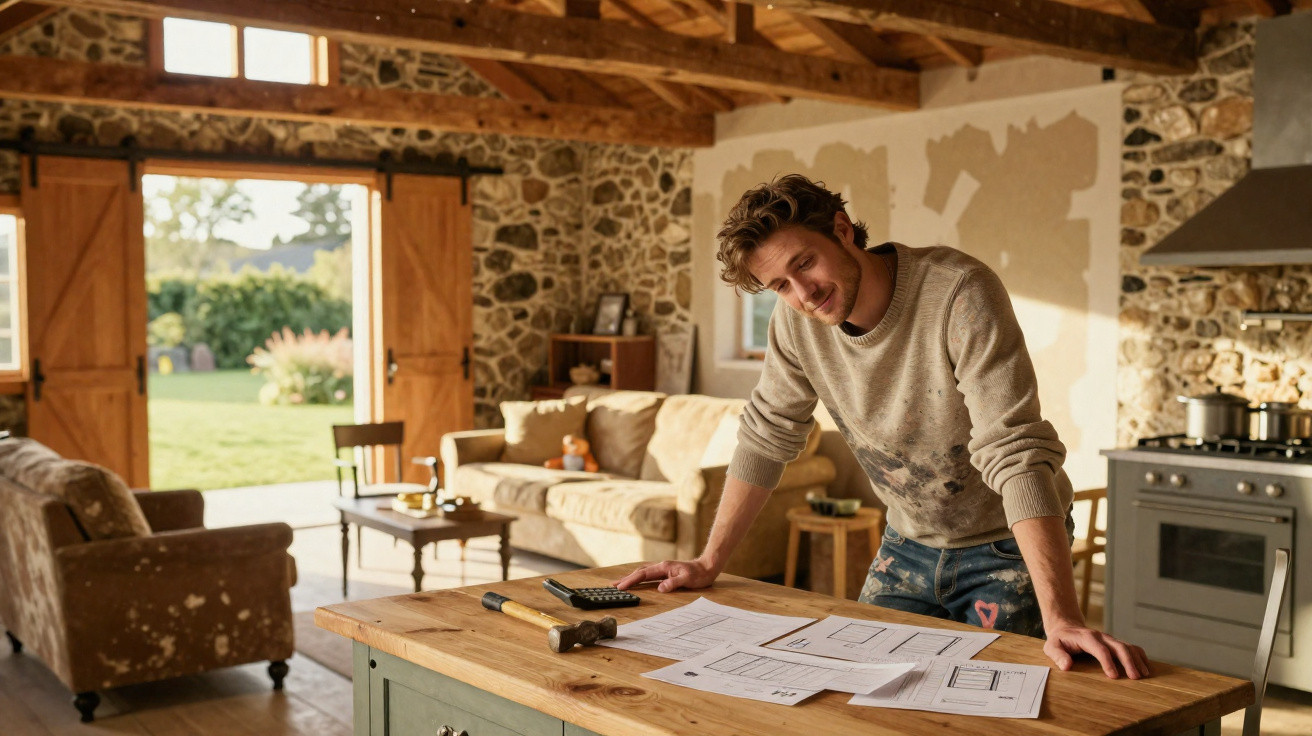
On Sunday mornings, in the small village he now calls home, Mathieu still opens the large wooden doors of his former barn before putting the coffee on. Three years after buying it, the stone walls retain their uneven surfaces, the floorboards creak in the hallway, and an old beam crosses the living room like a memory that cannot be erased. Bought for €45,000, the building seemed almost too good to be true: 140 m² to renovate, a modest plot, a tired roof and no insulation worthy of the name. Even so, his family moved in after two years of building work, uncertainty and bills that never arrived alone. He no longer romanticises any of it. Instead, he explains what worked, what slipped beyond his control and what he would do differently. The reality is less polished than the before-and-after photographs.
At €45,000, the barn looked like the bargain of a lifetime
The first viewing took place on a rainy day, which is far from insignificant when you are buying a barn. Mathieu remembers the smell of damp soil, the dark roof tiles and the light coming through an unglazed opening, where his daughter’s bedroom now stands. The asking price was startling in the best possible way: €45,000 for a building twenty-five minutes from a medium-sized town, while habitable homes in the area were already selling for more than €180,000. It was love at first sight, almost embarrassingly so. We all know that moment when we picture an entire life in a place that is still empty.
On paper, the scheme appeared manageable. Mathieu and his partner had a €70,000 deposit and expected to spend around €120,000 on the renovation, carrying out the painting, flooring and part of the internal fit-out themselves. Yet the first overall quote, received after the purchase, came to €198,000. Roof structure, drainage, plumbing, utility connections and joinery: every item revealed an issue nobody had spotted during the two viewings. “We had bought walls, not a house,” he now says with a slightly weary smile. That distinction transformed the entire project.
The trap was not the low price itself, but the gap between the dream and the building’s real condition. An old barn can provide unusual volumes, sturdy walls and a character that new builds struggle to replicate. It can also conceal weak foundations, rising damp or a roof that remains standing largely out of habit. Mathieu had brought in a tradesperson before signing, but not a project manager or structural engineering surveyor. He thought he was saving a few hundred euros; instead, he bought uncertainty. Three years later, he believes that saving cost him almost €15,000 in remedial work and delays.
Barn conversion work cost more than money alone
His advice is straightforward: before discussing an open-plan kitchen or a large glazed door, put a price on the elements you cannot see. Mathieu recommends obtaining thorough assessments of the roof, walls, drainage, electrics, water supply connection and ground conditions. It is also essential to check the local development plan, as converting an agricultural outbuilding into a home often requires a change of use, with rules that can be strict about openings and the external appearance. In his case, a garden-facing window had to be moved two metres following a request from the council. Three months were lost, and the budget had to be revised.
The biggest mistake involved insulation. To keep the exposed stonework visible, the couple wanted to insulate only from the inside, using thin materials so as not to reduce the generous spaces. It was an appealing idea, but the north wall remained cold and damp developed behind poorly ventilated internal lining. Part of it was removed the following winter, with no pleasure and no refund. Let us be honest: nobody truly does this every day-managing tradespeople, comparing quotes and trying to understand vapour barriers after a working day. Mathieu now advises keeping a contingency of 15 to 20% of the original budget, even when everything seems properly planned.
Despite the setbacks, several decisions stopped the renovation from becoming a complete money pit. The family retained the barn’s overall form, kept expensive new openings to a minimum and postponed fitting out the garage, which became temporary storage rather than a finished room.
“The right project is not the one that looks like a magazine: it is the one you can still afford and live in without exhausting yourself.”
- Have the structure inspected before signing the preliminary purchase agreement;
- Set aside a dedicated contingency fund;
- Give priority to the weatherproof shell, insulation and heating;
- Delay finishes that can wait a year or two.
Three years on: an imperfect home that is genuinely lived in
Today, Mathieu’s assessment cannot be reduced to one figure. The project cost him around €236,000 in total, including the purchase, fees, works and improvements-far more than the €165,000 initially envisaged. Even so, a renovated family home of this size would now sell for more in his area, without even considering its lived value: meals beneath the roof structure, children running in the garden and the workshop where he repairs his bicycle. The house is warm, bright and suited to their everyday lives. One façade still needs attention and one shower room remains unfinished. None of it is especially photogenic, but life is rarely perfectly framed.
What surprised him most was not the rising budget. It was the mental burden of the renovation, which continued into the evenings, when he had to choose a door handle while the mortgage funds had just been released and a tradesperson was waiting for an answer. His partner admits that they sometimes became absorbed in details to avoid confronting the real issues: money, exhaustion and an ever-slipping timetable. They moved in with a temporary kitchen and boxes lining the hallway. They now describe it as a bad memory tinged with pride. The house was finished enough to be lived in.
This account does not mean that every old barn is a sound investment. Rather, it is a reminder that a low purchase price never guarantees an affordable project, particularly when materials, energy and labour carry such weight. For some people, buying a home that has already been renovated will offer valuable peace of mind. For others, accepting the marks of a building site and progressing room by room will represent a kind of freedom. Mathieu does not advise anyone to copy his decision. He invites them to ask the right question: how much is it worth to you to create a place in your own image, with its visible flaws and quiet victories?
| Key point | Detail | Value for the reader |
|---|---|---|
| Attractive purchase price | Barn bought for €45,000, but uninhabitable as it stood | Avoid confusing a low price with the project’s true cost |
| Final budget | Around €236,000 after works, fees and unexpected costs | Build a realistic financial margin in from the outset |
| Main lesson | Prioritise the structure, insulation and utilities | Make the right trade-offs before decorative finishes |




Comments
No comments yet. Be the first to comment!
Leave a Comment