
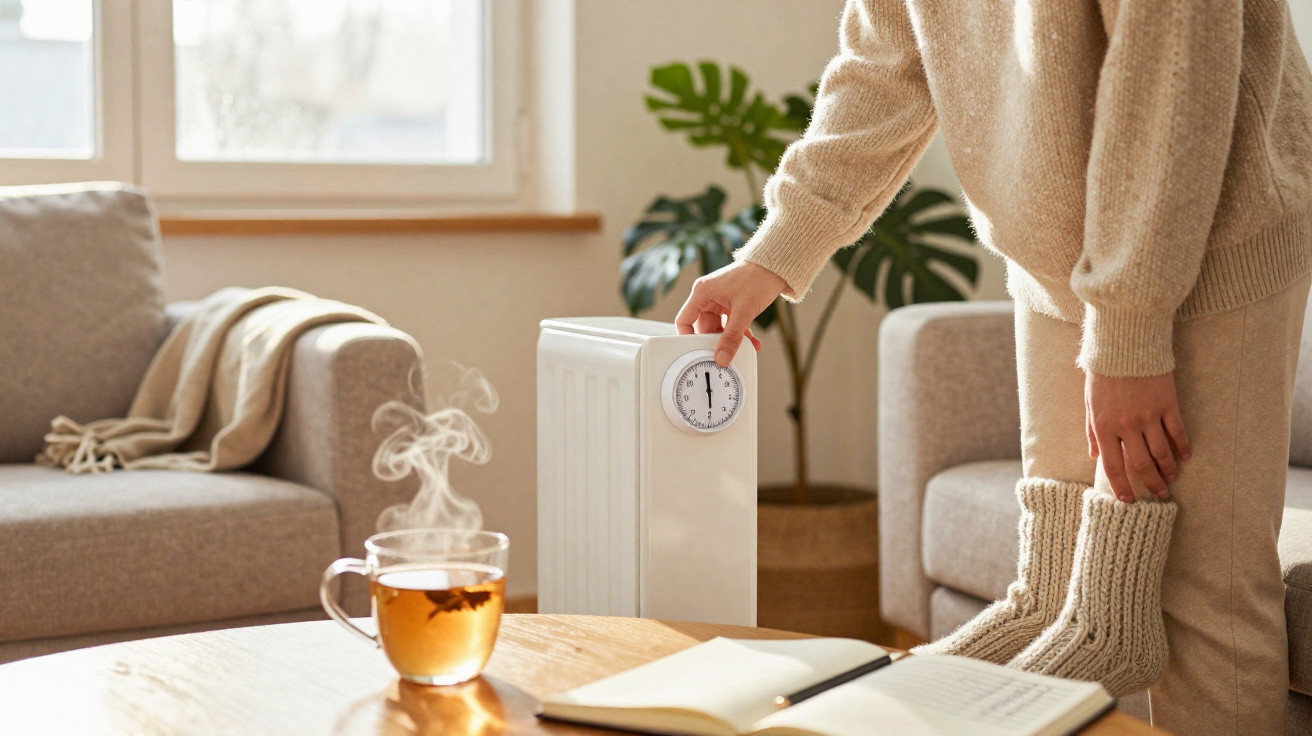
On a January Tuesday morning, the living room feels a little too quiet and the thermometer reads 21 °C. It is certainly not cold, but the boiler has been running since dawn and thoughts of the next bill soon creep into the morning coffee. Many households experience this without giving it much thought: one extra degree feels harmless, even reassuring, until the figures arrive. ADEME estimates that lowering the temperature from 21 °C to 19 °C can cut heating consumption by around 14 %. It is neither a miracle solution nor a rule that applies identically to every home, but it is a very practical benchmark. What if the real saving lay behind every door in the house?
Two degrees less: a small change with a significant effect on the bill
We all know the feeling of turning up the heating after arriving home, still chilled by wind or rain. The reaction is natural, yet keeping every room at 21 °C all day means heating spaces that do not always need the same level of warmth. ADEME notes that reducing the temperature by one degree delivers roughly 7 % in heating-related energy savings; moving from 21 °C to 19 °C therefore equates to an estimated 14 % reduction. Over a whole winter, that difference is no longer merely symbolic.
Take a home with annual heating costs of 1,800 euros, a figure that has become commonplace for many households using electricity, gas or oil. A theoretical 14 % reduction would save about 252 euros over the year, under comparable conditions. This calculation does not allow for changing energy prices or an especially mild winter, but it puts the scale into perspective: two degrees could pay for some food shopping, insurance or a family outing. That is far from insignificant.
The explanation is straightforward: the greater the gap between indoor and outdoor temperatures, the more heat the property loses through its walls, windows, roof and air leaks. The heating system must then work continuously to make up for it. At 21 °C, the feeling of comfort may seem ideal when sitting on the sofa, while at 19 °C, with a jumper, thick socks and a throw, many people notice hardly any difference. Comfort cannot be measured by a thermostat display alone.
A room-by-room approach to heating the spaces you actually use
The easiest method is to assess each room according to how it is genuinely used, rather than applying one temperature across the entire home. In the living room, where evenings are spent and where people may also work from home during the day, 19 °C is ADEME’s recommended reference point. In a bedroom, 16 to 17 °C is often enough for sleeping, particularly with an appropriate duvet. The bathroom can be heated to around 22 °C when washing, without being kept at that level from morning until night.
To make an estimate, start with the annual heating bill and divide consumption roughly between the heated areas. A household spending 1,800 euros a year could estimate that the living room and open-plan kitchen account for 800 euros, bedrooms for 500 euros, the bathroom for 150 euros and circulation areas for the remainder. Reducing the living area from 21 °C to 19 °C would save around 112 euros in that zone alone, based on the 14 % benchmark. Absolute precision is not possible, but the overall pattern soon becomes clear.
A common mistake is to turn off a radiator completely in a cold, damp room, then increase the heating in neighbouring rooms. This can lead to condensation, persistent discomfort and sometimes mould marks. Let us be honest: hardly anyone manages this perfectly every day, especially when the house is busy, children are running about or a cold snap sets in. It is better to aim for a lower, steady and suitable temperature, while keeping doors shut between rooms with very different uses.
Thermostats and radiators: everyday details that make a difference
A programmable thermostat turns this intention into an almost automatic habit. You can set 19 °C in the living space between waking up and leaving for work, lower it to 16 or 17 °C while nobody is home, then bring it back up shortly before returning, depending on the property’s thermal inertia. Smart radiators can sometimes provide room-by-room control, but even ordinary thermostatic radiator valves, used properly, can make a substantial difference. The aim is not to live in the cold, but simply to avoid heating an empty house at full power.
The thermometer’s position also matters: if it is placed near a radiator, patio door or draught, its reading can be misleading. A temperature of 19 °C measured in the right location - around 1.50 metres above the floor and away from direct heat sources - makes it easier to adjust the heating without trial and error. Closing shutters at nightfall, drawing the curtains and moving a sofa away from a concealed radiator are modest measures. They prevent the system from working harder to achieve the same result.
The adjustment can feel difficult for the first few days, particularly in a home where 21 °C has become a family habit. However, the body often adapts more quickly than expected, provided that energy restraint is not confused with lasting discomfort.
“A temperature of 19 °C in living areas is generally sufficient to combine comfort with controlled consumption,” ADEME states in its recommendations on domestic heating.
- Living room and occupied kitchen: aim for 19 °C rather than 21 °C.
- Bedrooms: keep them at 16 to 17 °C overnight, depending on habits and insulation.
- Bathroom: heat it more only when it is being used.
- Unoccupied rooms: maintain a lower temperature rather than switching heating off during a prolonged cold spell.
A better-regulated home without giving up winter comforts
Reducing the temperature from 21 °C to 19 °C will not, by itself, solve the problem of poorly insulated homes, ageing boilers or soaring bills. It is an immediate and accessible action that becomes even more meaningful alongside good ventilation, maintained window seals and regular monitoring of energy consumption. Above all, a room-by-room calculation avoids one unhelpful reflex: treating the home as a single large space when every area has its own routine, occupants and requirements.
For some households, 19 °C will be ideal; for others, the presence of a baby, an older person or someone in fragile health will require adjustments. The right setting is one that safeguards comfort and health without encouraging unnoticed waste. Looking at the thermostat this evening, room by room, can become a revealing exercise: which rooms are being heated for nobody, and which ones genuinely deserve a little more warmth?
| Key point | Detail | Benefit for the reader |
|---|---|---|
| 21 °C to 19 °C | Around 14 % in heating savings, according to ADEME’s benchmark | Quickly see the possible reduction in an annual bill |
| Room-by-room settings | 19 °C in the living room, 16 to 17 °C in bedrooms, and up to 22 °C in a bathroom when in use | Maintain comfort without heating the whole home uniformly |
| Bill example | On 1,800 euros of annual heating costs, 14 % represents around 252 euros | Turn an abstract recommendation into a tangible amount |






Comments
No comments yet. Be the first to comment!
Leave a Comment