
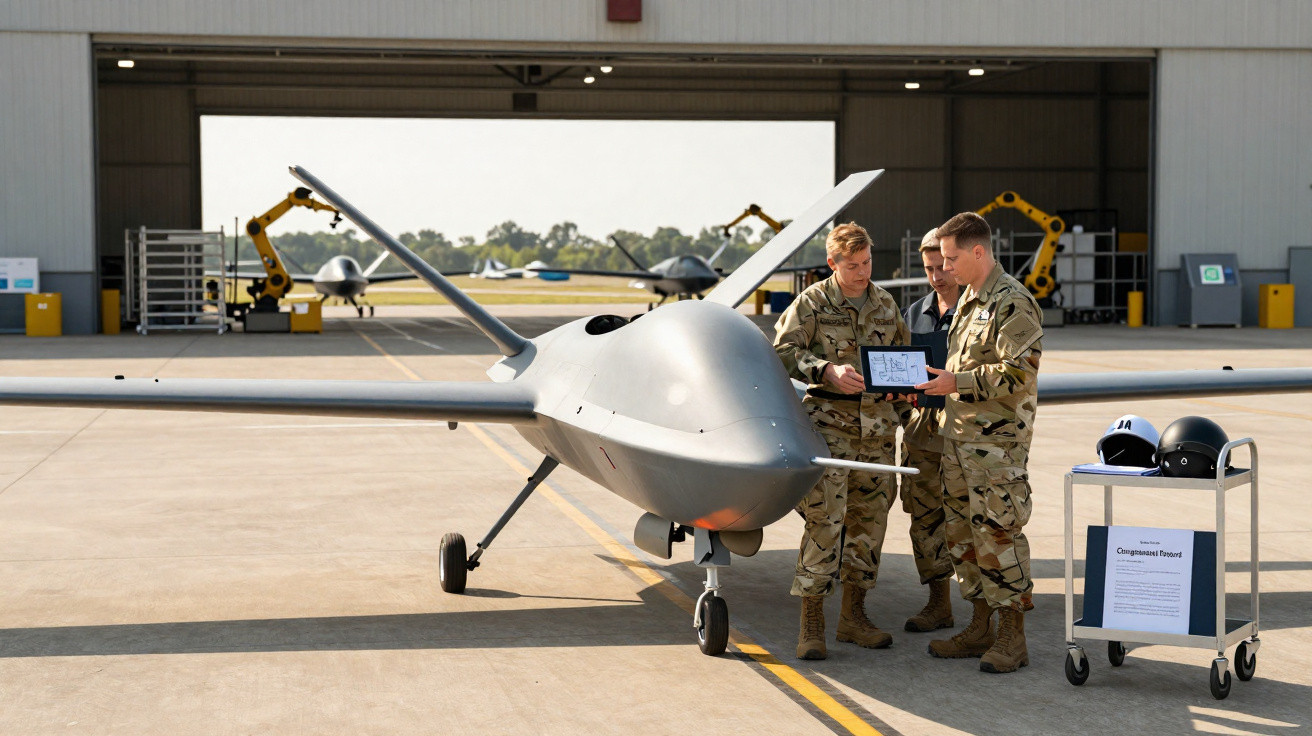
General Atomics, the US company, has recently unveiled the Wildfire concept, a medium-altitude, long-endurance unmanned aerial system. Military analysts believe this new platform is intended to replace the United States’ MQ-9 Reaper fleet. Its emergence responds to an urgent strategic requirement to restore remotely piloted assets following major operational losses.
Recent military action against Iran and combat operations against the Houthis in Yemen caused severe attrition. As a result, defence planners are now assessing how the current fleet performs in contested environments. The United States Air Force (USAF) is seeking a sustainable platform based on an open architecture.
A report entitled “U.S. Aircraft Combat Losses in Operation Epic Fury: Considerations for Congress” outlines these difficulties. The Congressional Research Service (CRS) document records a total of 24 MQ-9 Reaper drones lost since operations began. At present, the military institution has a fleet of 135 units in active service.
Congressional Reports Underline Major Combat Losses
The defence department plans to replace the lost unmanned aircraft with platforms that can be produced at scale. It also requires an affordable design that can be deployed rapidly during high-intensity warfare. The initiative comes as the manufacturer adjusts its corporate strategy to meet new national security demands.
General Atomics has not yet publicly released official images of the Wildfire concept. Nevertheless, company spokesperson C. Mark Brinkley discussed the project with The War Zone. According to Brinkley, Wildfire “represents a significant leap forward from what the Pentagon is currently looking for in a new MALE combat drone.”
The existing MQ-9A Reaper is powered by a Honeywell TPE331-10 turboprop engine and incorporates a highly modular design. Its configuration supports the fitting of electro-optical equipment, infrared sensors, radars, electronic support measures and weapons. The aircraft has a payload capacity of 1,746 kilograms and an endurance exceeding 27 hours.
Pentagon Innovation Units Pursue Sustainable Mass Production
The older drone can reach 240 knots and operate at a maximum altitude of 50,000 feet. To strengthen these capabilities, the manufacturer carried out flight tests using Advanced Precision Kill Weapon System (APKWS) guided rockets. The system can effectively bring down hostile drones, while special units are incorporating GBU-39B glide bombs into their inventories.
Through the Defense Innovation Unit (DIU), the Department of War (DoW) launched the Massless Modular Aircraft (MMA) solicitation. The organisation wrote on social media: “For decades, the Joint Force has relied on low-density, high-value, ‘exquisite’ (>$30M) manned and unmanned aircraft. In a high-intensity fight, this model is simply unsustainable.”
The defence agency is looking for an affordable, theatre-range, massed and risk-tolerant unmanned system able to carry long-range payloads. The new aircraft must accommodate a range of sensors in order to perform missions currently undertaken by the MQ-9A. Brinkley confirmed that General Atomics submitted a proposal to the MMA programme, although the Wildfire aircraft is not solely dependent on that initiative.




Comments
No comments yet. Be the first to comment!
Leave a Comment