
Add Zona Militar to Google
Why add us? Get Zona Militar news on Google.
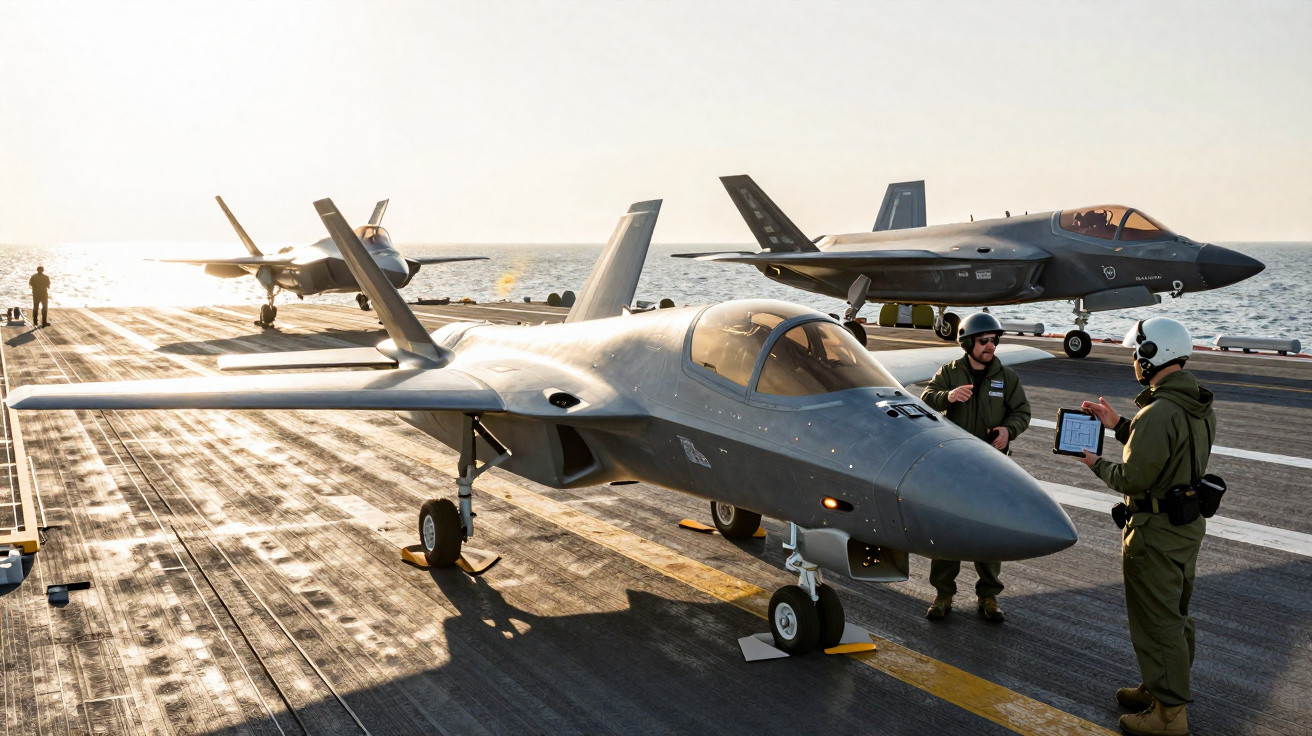
The United States Navy has formally begun the process of bringing collaborative combat drones into its carrier air wings. A new industry consultation calls for two fully operational prototypes, each capped at US$30 million, able to operate from Nimitz-class and Gerald R. Ford-class aircraft carriers.
👉 Read more: US Air Force declares Initial Operational Capability for the new MH-139A Grey Wolf helicopter to strengthen the nuclear arsenal
Issued on 31 August, the Request for Information (RFI) gives industry three years to make the aircraft available. The Navy is therefore advancing its own branch of the Collaborative Combat Aircraft (CCA) concept, which has so far been driven principally by the United States Air Force and Marine Corps.
The naval service's initial priority, however, differs from that of the other services. Rather than focusing its first effort on the most sophisticated platform possible, the Navy wants to bring a comparatively affordable aircraft into carrier operations quickly. Later designs could gain more advanced capabilities based on the experience gathered from these first prototypes.
📌 You may also be interested in:
- Republic of Korea Navy: KSS-III Dosan Ahn Chang-ho submarine completes historic Pacific mission
- US Air Force deploys B-52H bombers to Australia to reinforce the Indo-Pacific
Up to four external weapons and F-35C and F/A-XX integration
Requirements released through the federal SAM.gov portal describe an aircraft designed from the outset to share the limited carrier deck space with today's embarked fighters. Its deck footprint must not exceed that of a fourth-generation fighter, and all operations must be compatible with the infrastructure of the Nimitz and Ford classes.
Its weapons load will also be substantial. Every CCA must be able to carry as many as four externally mounted 1,134 kg weapons, enabling the drones to supplement crewed aircraft across a range of mission types.
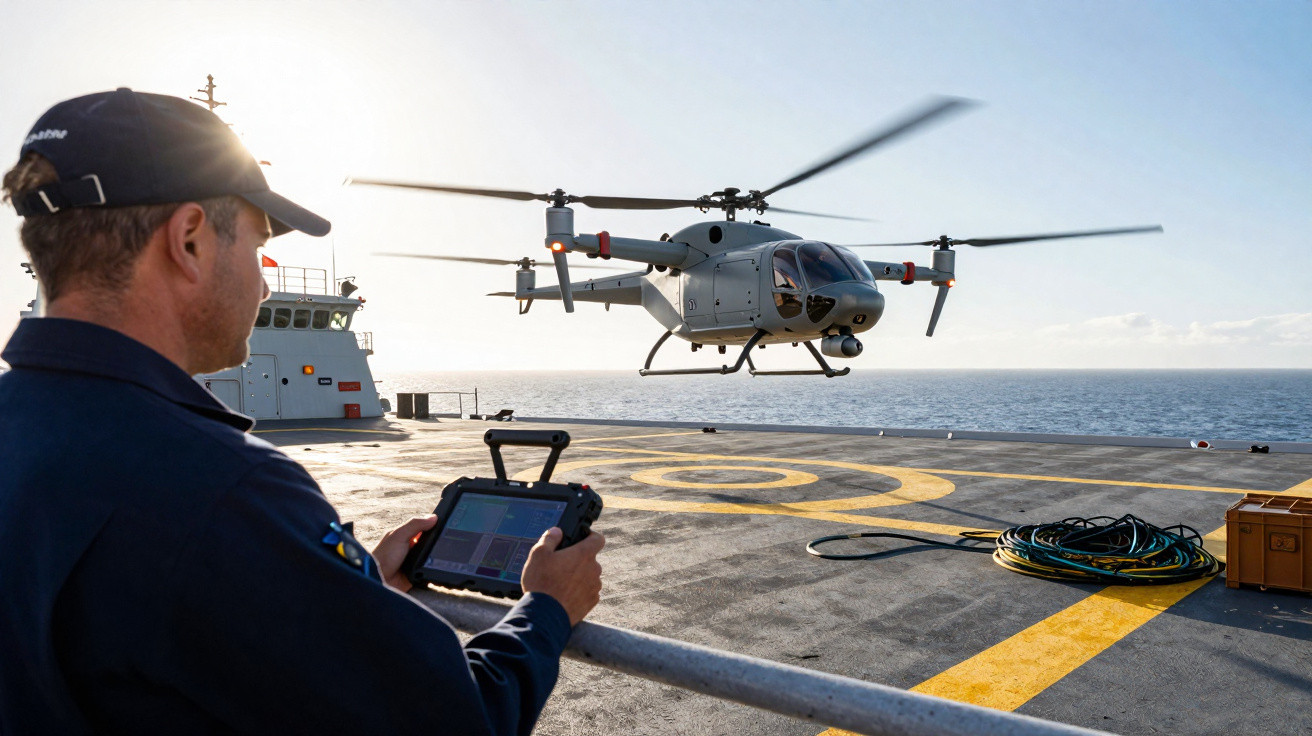
Control will be provided by the MD-5 Unmanned Carrier Aviation Mission Control System, connecting the new platforms to the architecture the Navy has developed for uncrewed air operations. The RFI also requires an industrial base, together with a provisional manufacturing and supply chain, capable of supporting the programme.
In time, these drones are expected to operate alongside the F-35C Lightning II and the F/A-XX. The latter is the future next-generation carrier fighter intended to take over roles currently carried out by the F/A-18E/F Super Hornet and EA-18G Growler.
Navy CCA prototypes designed for carrier operations
Although the industry consultation marks the formal start of the search for prototypes, preparations for integrating CCAs into carrier air wings had already been under way.
In January, the Naval Air Warfare Center Aircraft Division (NAWCAD) used its Joint Simulation Environment to examine combined operations involving the F-35 Lightning II and collaborative drones. This work allowed tactical concepts to be developed and assessed before a definitive naval platform even existed. Such preparation will be particularly important because of the specific demands of carrier operations. Besides accompanying crewed aircraft in combat, a naval CCA will need to accommodate restricted deck space, launch and recovery cycles, and the existing onboard control infrastructure.
Closing the gap with the US Air Force CCA programme
The Navy is also seeking to narrow the gap with the Air Force, whose first CCA programme increment has already reached a more advanced stage with Anduril's YFQ-44A Fury and the YFQ-42A from General Atomics.
For instance, the YFQ-44A conducted its first launch of an AIM-120 AMRAAM air-to-air missile in July, moving towards effective weapons integration after earlier trials with inert payloads. Anduril subsequently confirmed completion of the first aircraft built at its Arsenal-1 facility in Ohio, which then headed to the Nevada desert for another evaluation campaign. For the Navy, publication of the RFI still represents a stage before a formal competition is opened. Industry responses will be used to assess whether the requirements are feasible and to prepare a possible request for proposals covering the two prototypes.
The ultimate aim is to add a larger number of combat platforms to carrier air wings without relying solely on expensive crewed fighters. In this way, CCAs could increase the number of sensors and weapons available during a mission while taking on some of the risk in high-intensity scenarios, thereby preserving crewed aircraft and their crews.




Comments
No comments yet. Be the first to comment!
Leave a Comment