
Add Zona Militar to your Google feed
Why add us? Get the latest updates from Zona Militar in your Google feed.
Join the WhatsApp channel
Join our official WhatsApp channel and receive the news as it happens.
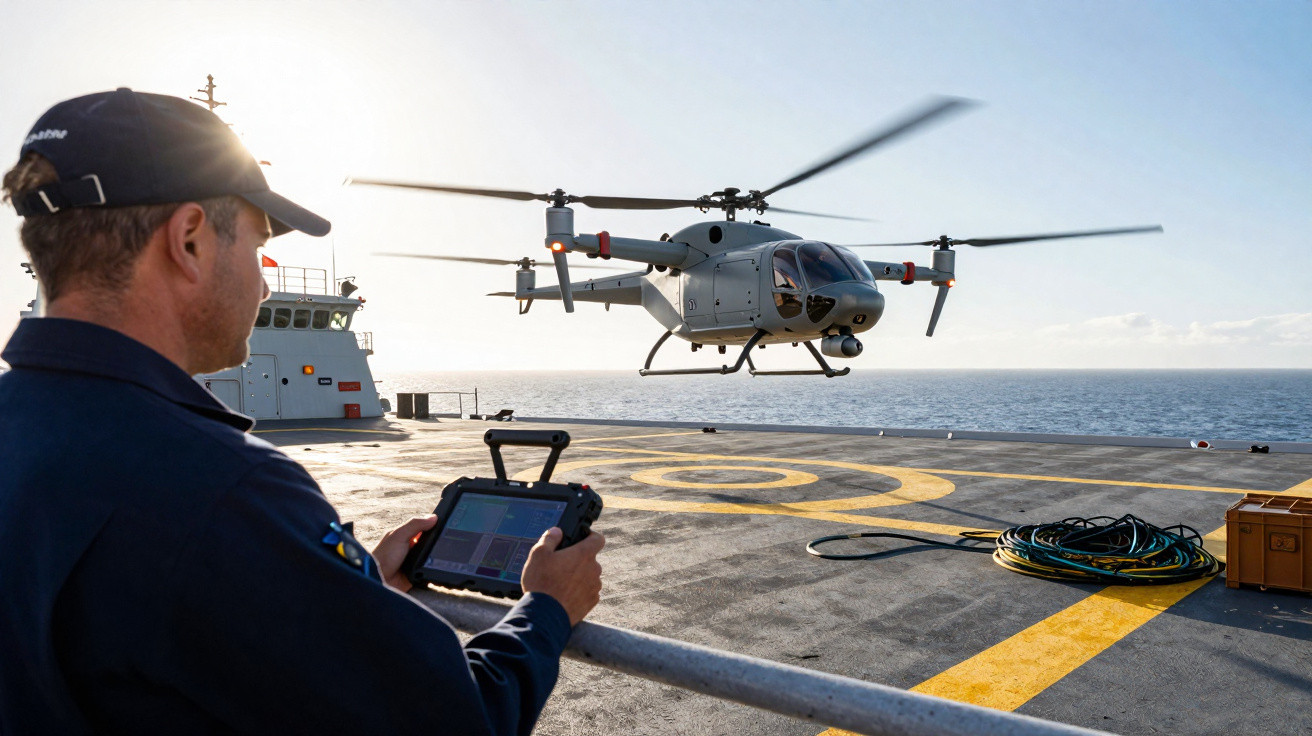
In a move to expand its air-naval capabilities through new uncrewed technologies, the Spanish Navy is progressing with the acquisition of a VTOL A900 unmanned aerial vehicle (UAV) from local company Alpha Unmanned Systems. The procurement contract has a budget of €1.3 million. The forthcoming UAV will be assigned to the institution’s Centre for Experimentation and Unmanned Vehicles (CEVENTA), based at Rota Naval Base.
👉 Read more: British aircraft carrier HMS Queen Elizabeth returns to service to lead a three-month deployment in Northern Europe
Spanish Navy procurement processes for UAV systems
At the start of June, the Economic Management Directorate of the Spanish Navy’s Logistics Support Headquarters announced a tender to purchase a Class I RPAS, with a base budget of €1.324.455 million. According to the information released, the RPAS (Remotely Piloted Aircraft System) will comprise at least three autonomous, remotely controllable rotary-wing UAVs in a maritime configuration; two of them must be fitted with electro-optical/IR sensors.
The procurement package also covers four control stations, a simulator, three AIS units and an initial logistics package, in addition to training for operators and technicians. Another requirement specifies that the selected RPAS must demonstrate operational maturity, considering: “...that it is in service with or has been acquired by the navy of another NATO country; that it has been acquired by the Spanish Armed Forces or State Security Forces; that it has been successfully tested aboard Navy vessels in formal trials; and that it can provide references for use by maritime-sector organisations such as coastguard or maritime police forces...”.
📌 You may be interested in:
- Following RIMPAC and Pacific Dragon, the Spanish Navy’s Álvaro de Bazán continues its Pacific deployment with the GALAPEX exercise
- Satellite imagery may reveal the Russian Navy’s first naval drone port near the Black Sea
Deployment of the A900 aboard the Spanish Navy’s BAM Rayo
Along these lines, in May this year the Spanish Navy completed a tactical flight exercise aboard the BAM Rayo (P-42), involving an Alpha Unmanned Systems A900, an Airbus Flexrotor UAV and an H135 helicopter. The event incorporated the UAVs into a maritime ISTAR operation and created a multidomain operational link between the Spanish vessel, the crewed aircraft and the uncrewed systems. The A900 was integrated into an arrangement allowing a single crewed operator to control drones from different manufacturers within the same tactical scenario, using the HTeaming tool.
A900 UAV characteristics
The A900 is a VTOL (Vertical Take-Off and Landing) unmanned aerial vehicle developed by Spanish firm Alpha Unmanned Systems. It has a wingspan of 2.1 metres, a 4-kilogram payload capacity and a maximum take-off weight of around 25 kilograms. The platform offers an endurance of up to 4 hours and can reach a top speed of 100 km/h. As the company explains, the A900 was designed for maritime use and has automated take-off, flight and landing capabilities from moving vessels.
Other notable A900 applications include intelligence, surveillance and reconnaissance (ISR) missions, border control, search and rescue, infrastructure inspection, and cooperation with crewed and uncrewed systems. Given the operational and technical requirements set out in the tender, the model selected by the Spanish Navy must be capable of conducting reconnaissance, surveillance and “...logistical or weapons-launch missions...”.
Spanish Navy procurement programmes for uncrewed systems
Alongside this latest acquisition, the Spanish Navy is advancing the incorporation of two new uncrewed surface vehicles (USVs) for multimission and anti-surface warfare operations. The tenders represent a total investment of €2.5 million for both USVs, which the institution aims to purchase before the end of 2026. As noted, adding these new uncrewed technologies will not only enable the Navy to extend its operational reach across a range of maritime missions using autonomous systems, but will also strengthen their integration with the naval force’s crewed capabilities.





Comments
No comments yet. Be the first to comment!
Leave a Comment