
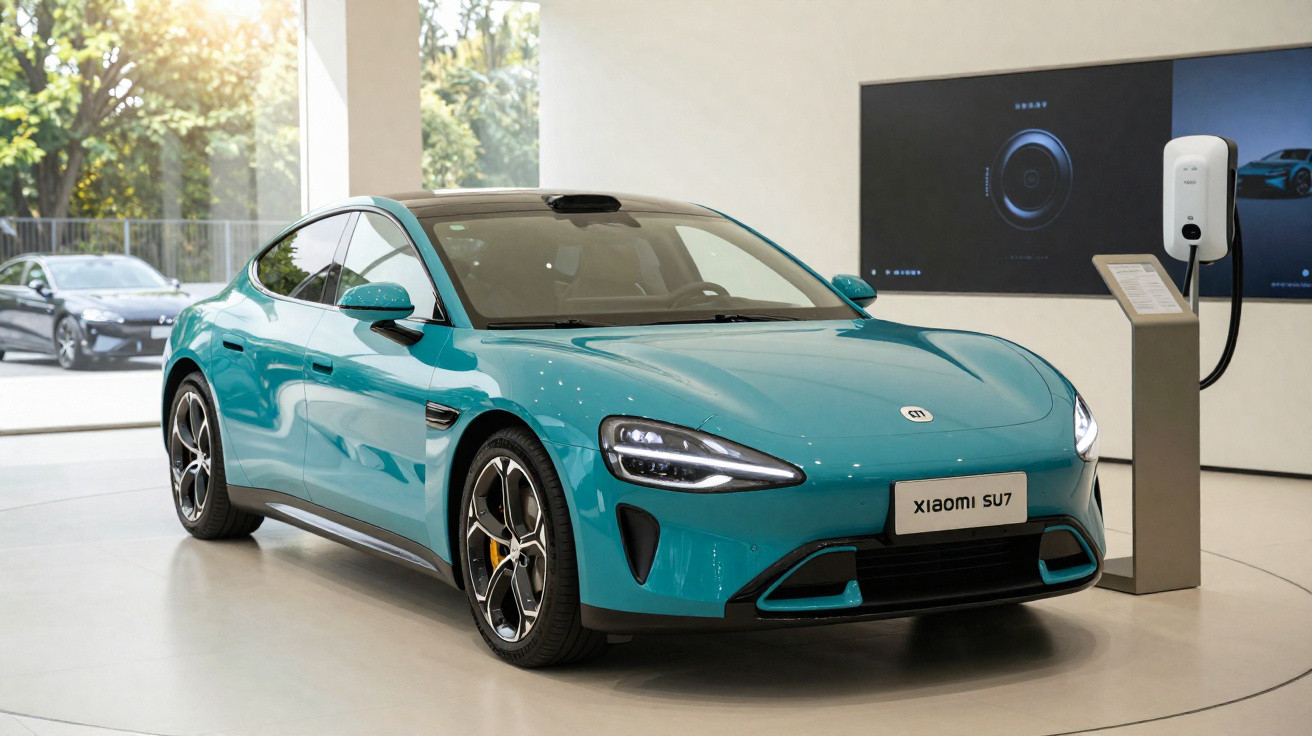
Nearly three years after its initial announcement, and following €1.277 billion of investment, Xiaomi has finally unveiled its first car: the SU7. Unlike its smartphones, however, this is not something you can slip into your pocket.
The Chinese technology giant’s first automotive product is a generously proportioned all-electric saloon, measuring roughly five metres long and nearly two metres wide. It combines sports-car-rivalling performance - the most powerful version reaches 100 km/h from rest in 2.78 seconds - with long-range credentials, at least under the lenient Chinese CLTC test cycle.
“Xiaomi wants to become one of the world’s five largest car manufacturers within the next 15-20 years.”
Lei Jun, Xiaomi chief executive
Xiaomi is not being modest in its ambitions, positioning the SU7 against cars such as the Tesla Model S and Porsche Taycan. Is that an overly bold target? Here is a closer look at the new model.
The most aerodynamic production car of all
The new Xiaomi SU7 immediately lays claim to the lowest drag coefficient of any production car in the world, at just C_x 0.195. That undercuts the Mercedes-Benz EQS at 0.20 and the Tesla Model S at 0.208.
Its sleek, flowing profile - which brings the Taycan to mind - is likely to play a part, as does the identity of its designer. The exterior was penned by James Qiu, who has experience creating highly aerodynamic vehicles. He was among those responsible for the Mercedes-Benz Vision EQXX concept, which has a C_x of 0.17.
The SU7’s aerodynamic features also include an active lower air intake, which can open and close across 16 settings depending on requirements, plus an active rear wing with four adjustment levels. It also gets air suspension and adaptive damping.
Xiaomi SU7: electric power with “V6” and “V8” motors
Xiaomi’s first step into the car industry has been introduced in two forms: the entry-level SU7 and the SU7 Max. Their principal differences lie in their powertrains and technology specification.
Both are based on the same platform, named… Modena. Yes, the Italian city that is home to Ferrari and Maserati.
Someone at Xiaomi clearly has a sense of humour, as the motors fitted to - and planned for - this exclusively all-electric model are called the HyperEngine V6, HyperEngine V6s and HyperEngine V8s - yes, you read that correctly… V6 and V8, as though these were combustion engines…
These electric motors stand out for the revs they can reach. The V6 and V6s can both spin at up to 21,000 rpm, while the V8s, due to arrive only in 2025, is claimed to reach 27,200 rpm. Xiaomi is not stopping there either, as it is developing a motor capable of 35,000 rpm through the use of carbon fibre.
The standard SU7 uses a rear-mounted HyperEngine V6, giving it rear-wheel drive. It produces 220 kW (299 hp) and 400 Nm of torque, and accelerates from 0 to 100 km/h in 5.28 seconds.
In the SU7 Max, the “V6” is fitted to the front axle, while the rear axle receives the V6s, rated at 275 kW or 374 hp and 500 Nm. This creates four-wheel drive, with a combined maximum output of 495 kW (673 hp) and 823 Nm of torque. It reaches 100 km/h in a scant 2.78 seconds and has a 265 km/h top speed.
Up to 800 km of range on the Chinese cycle
Beyond their mechanical differences, the two SU7 versions also use notably different batteries, starting with their electrical architecture. Although the Modena platform supports more than 800 V, the standard SU7’s battery is limited to 400 V.
It uses LFP (lithium iron phosphate) chemistry, is supplied by CATL and has a 73.6 kWh capacity. This provides a claimed 668 km of range under China’s CLTC cycle - under the WLTP cycle used here, its range will be lower, with the figure beginning with a “5”.
The SU7 Max, meanwhile, receives an 875 V, 101 kWh battery. Also supplied by CATL, it uses the more energy-dense NMC (nickel, manganese and cobalt) chemistry. Xiaomi quotes an 800 km range for this version, once again under the lenient Chinese test cycle.
Giant screen, but physical controls remain
Inside, the design follows current trends, using horizontal lines and a vast central 16.1-inch touchscreen with 3K resolution as the dominant feature.
Unlike Tesla and certain others, Xiaomi gives the driver a 100% digital instrument panel, with a 7.1-inch display placed directly ahead, while retaining some physical controls.
Rear passengers also have access to two displays mounted behind the front seats, which are in fact Xiaomi tablets, or Mi Pads.
Everything in the cockpit is controlled by the HyperOS operating system, powered by Qualcomm Snapdragon 8295 processors. The advanced driver-assistance systems, known as Xiaomi Pilot, are instead powered by two Nvidia Orin-X chips, offering 508 TOPs, or trillion operations per second, of computing power.
The SU7 Max also comes with a LiDAR unit for its advanced driver-assistance systems, mounted immediately behind the top of the windscreen - the bulge visible in some images - and offering a range of up to 200 m. It is backed up by an “arsenal” of radars, 12 ultrasonic sensors and cameras. In other words, it has the potential for autonomous driving, and Xiaomi will test it in that role across 100 Chinese cities throughout 2024.
The largest frunk in its class
The Xiaomi SU7’s considerable exterior dimensions translate into generous room inside, with the Chinese brand promising ample space, particularly for rear-seat passengers. That matters greatly in China, where extended-wheelbase versions of many familiar models are sold.
It also promises to carry everything its occupants might need, with a 517-litre boot supplemented by the largest frunk - or front boot - in its class, at 105 litres. That exceeds the Model S’s 89 litres and the Taycan’s 84 litres.
When will it arrive?
Mass production of the new Xiaomi SU7 is scheduled to begin during the first half of 2024 at one of BAIC’s (Beijing Automotive Industry Holding Co. Ltd) factories in China.
This first presentation did not reveal a date for the initial deliveries or any pricing.
Given that Xiaomi regards the Tesla Model S and Porsche Taycan as rivals, prices might be expected to sit close to those of these models.
CarNewsChina is more optimistic, however, predicting that the entry-level SU7 will start at 300,000 yuan, a little over €38,100. For comparison, the Model S starts at €88,900 in China.
Will the Xiaomi SU7 reach Europe - and the United Kingdom in particular?





Comments
No comments yet. Be the first to comment!
Leave a Comment