
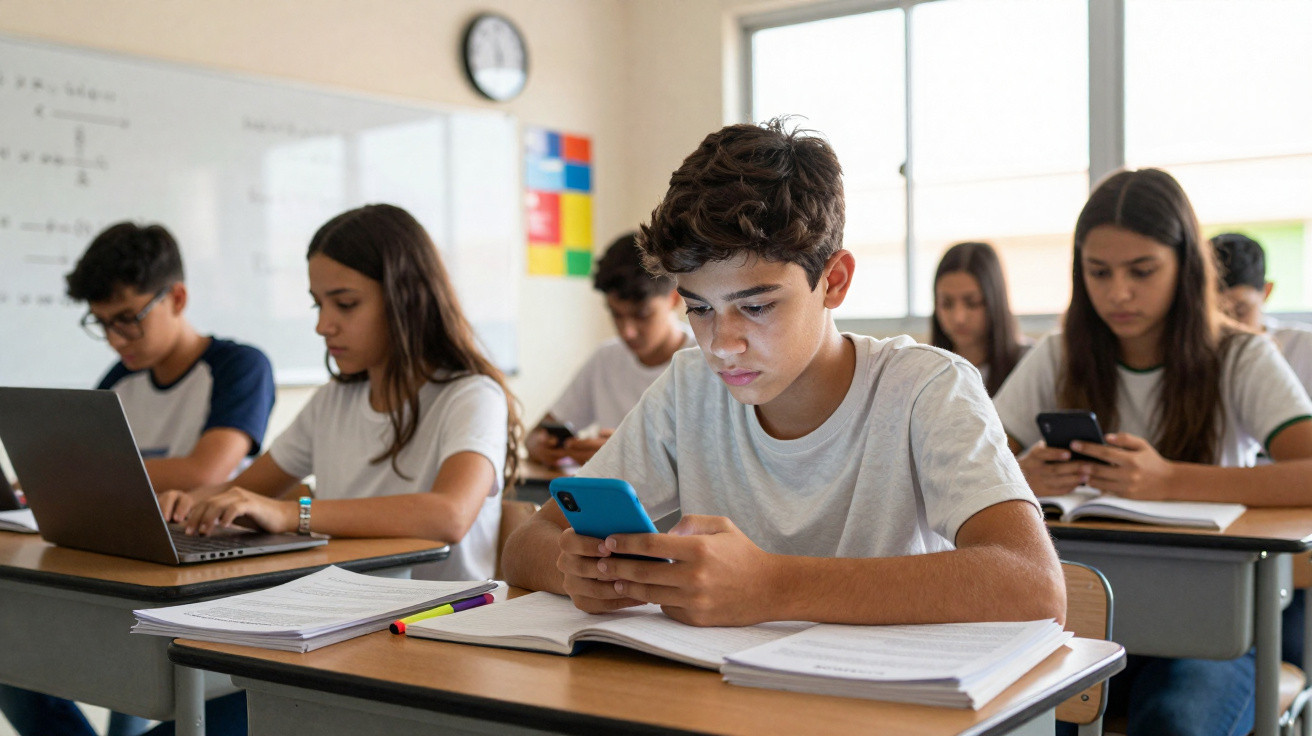
A glance at a phone can last only a few seconds, yet those seconds accumulate over the course of a school day.
New research indicates that middle and high school students spend almost a third of the school day using smartphones, looking at them dozens of times during lesson hours.
This continual sequence of interruptions may carry a price. Researchers linked frequent checking with poorer attention and self-control - the skills pupils need in order to remain involved in class.
Tracking students’ phone use
Throughout a normal school day, phone activity appeared in every hour, from the morning bell through to the final lesson.
Over a two-week period, Eva Telzer of the University of North Carolina at Chapel Hill (UNC-Chapel Hill) recorded how regularly adolescents returned to their phones while at school.
Almost every pupil in the sample used a smartphone during class time, with average total use exceeding two hours across the school day.
That constant presence prompts a more pressing question: how do repeated interruptions affect the attention pupils need to participate in lessons?
The scale of student phone use
Students spent an average of around 2.2 hours on their phones during the school day, checking them approximately 64 times.
As use occurred in every hour, these checks were not confined to lunch or one particularly boring lesson; instead, they were distributed throughout the day.
Usage also varied greatly. While some pupils recorded only eight minutes of phone use at school, others spent over five hours on their devices.
This variation suggests that schools could gain more from addressing the most intensive patterns of use than from applying identical measures to every pupil.
Age also influenced the role phones played during the day. Older pupils averaged roughly 23 minutes of phone use each hour, compared with about 12 minutes for younger pupils.
Outside school hours, though, the two groups were far more similar. Younger teenagers cut their phone use more on school days than on non-school days, whereas older teenagers appeared less influenced by that daily structure.
The findings suggest that early adolescence could be an important period for establishing healthier phone habits before routines become more difficult to alter.
What students did on phones
Social media and entertainment made up much of pupils’ phone activity during school hours. For younger pupils, these apps represented almost 70 percent of their phone use.
“What surprised us most was the sheer amount of time teens are on their phones during school,” said Kaitlyn Burnell, a research assistant at UNC-Chapel Hill and co-author of the study.
Built to provide rapid social rewards and effortless entertainment, these apps can be particularly appealing to check repeatedly throughout the day. Even a short look can shift attention from a lesson back to the screen.
However, the study’s strongest result concerned not merely the length of time pupils used their phones, but how frequently they checked them. Every glance requires the brain to leave one activity and switch back to another, fragmenting attention into brief periods.
“Our findings show that frequent phone checking may undermine the very skills students need to succeed in the classroom,” said Telzer.
The finding indicates that schools may need to focus less on overall screen time and more on the ongoing disruptions caused by repeated checking.
How phones affect focus
Cognitive control appeared to be the ability most affected - the brain’s capacity to concentrate on a goal while resisting immediate impulses.
Researchers assessed this skill using a straightforward laboratory task. Teenagers needed to press a button for some images and refrain from pressing it for others, testing how effectively they could manage their responses and organise their attention.
As only older pupils completed this task, the attention findings are based on a smaller section of the sample.
Despite that constraint, the pattern reflects what many teachers already observe: regular phone interruptions may make it more difficult for pupils to concentrate on schoolwork.
A wider phone backdrop
Beyond lessons, phones already occupy a major place in teenagers’ lives. Around 95 percent of US teenagers say they can access a smartphone, while almost half report being online nearly all the time.
Comparable trends have emerged in other studies of school hours. Research monitoring 117 adolescents recorded around 1.5 hours of phone use during the school day, indicating that these new findings are not exceptional.
Previous research by the UNC team also connected frequent social media checking with changes over time in the brain’s response to rewards.
Together, these studies suggest a wider pattern in which rapid, repeated phone checks are becoming a standard feature of teenagers’ everyday lives.
What the study missed
The findings nevertheless have significant limitations. Researchers followed 79 pupils in one school district, so the results may not represent every school or area.
Every participant used an iPhone because Android devices could not supply the detailed hourly usage information required by the researchers.
The data also did not separate phone use by different parts of the school day. A brief check at lunch, between lessons or during a break was recorded in the same way as a check made in class.
Lastly, the research identifies patterns rather than establishing cause and effect. Although frequent checking was associated with weaker attention, the results cannot demonstrate that phone use directly caused those differences.
Rethinking student phones in schools
Schools seeking solutions may require policies that address habits, since continual checking was the most harmful pattern identified by the study.
Telzer said schools should restrict access to social media and entertainment apps during teaching time, while the authors noted that digital literacy teaching could complement such policies rather than take their place.
This wider strategy matches the evidence because phones remain with pupils well beyond the classroom, and habits rarely end when the school day finishes.
In the study, phones were not simply present: they were embedded in the day, repeatedly eroding pupils’ concentration.
Rather than greater panic, the next helpful move may be clearer policies and stronger habits that cut down constant interruptions.




Comments
No comments yet. Be the first to comment!
Leave a Comment