
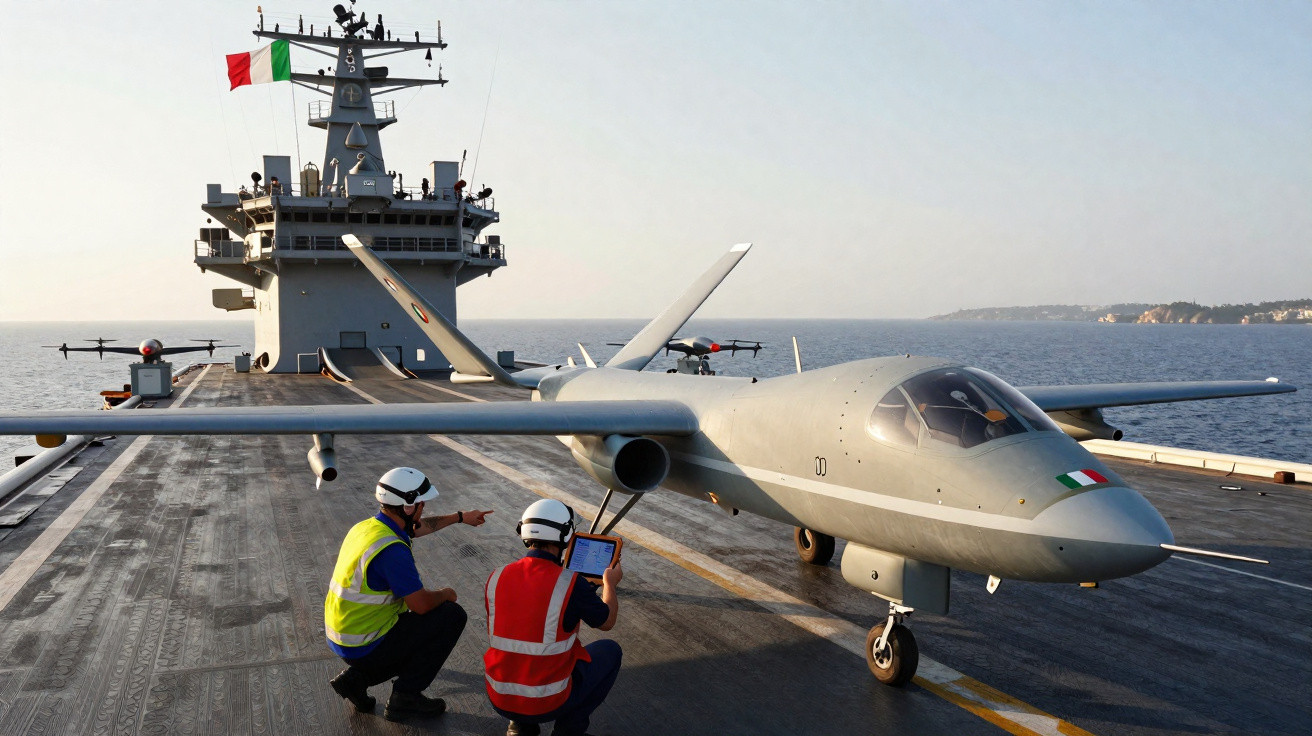
Cavour and Bayraktar TB3 integration
Italy’s aircraft carrier Cavour, operated by the Italian Navy (Marina Militare), and Turkey’s Bayraktar TB3 drones are set to mark an important development for European naval aviation. Italy has confirmed its planned integration of the TB3 system aboard its leading power-projection vessel. Vice Admiral Berutti Bergotto announced the decision during his 25 March appearance before the Italian Senate’s Foreign Affairs and Defence Committee. He stated that the procurement would be completed through Leonardo, under a co-operation agreement with the Turkish manufacturer Baykar. The officer added that the platform will be able to operate from Cavour in surveillance and weapons-carrying roles.
In his parliamentary address, Vice Admiral Bergotto said that the Italian Navy is moving ahead with the introduction of the TB3, an unmanned combat aerial vehicle (UCAV) developed by Baykar for operations from short-deck aircraft carriers. He explained that Leonardo will manage the integration, although the platform can also be obtained through LBA Systems, a joint venture formed by Leonardo and Baykar. The confirmation is the clearest indication yet that Italy intends to add a fixed-wing UCAV to its embarked air component, complementing its crewed aircraft and helicopters.
Through this purchase, Italy will become the first European customer for the Bayraktar TB3, a navalised development of the Bayraktar TB2, which has been exported to more than 30 countries. The TB3 was created for use from light aircraft carriers and vessels with limited flight decks, making it a suitable option for expeditionary operations. Indonesia had previously been named as the model’s first international operator after purchasing both land-based and carrier-capable variants, highlighting growing global interest in UCAVs suited to embarked missions.
Bayraktar TB3 carrier capabilities
The TB3 incorporates folding wings, strengthened landing gear and systems adapted for maritime conditions, enhancing its suitability for aircraft carriers such as Turkey’s TCG Anadolu. During NATO’s Steadfast Dart 2026 exercise, TB3s operated from that vessel and demonstrated intelligence, surveillance and reconnaissance (ISR) capabilities, alongside strike functions. Introducing a comparable system aboard Cavour would represent a step forward for the Italian Navy, which already operates F-35B short take-off and vertical landing (STOVL) aircraft.
Vice Admiral Bergotto’s presentation came as the Italian Navy expands its portfolio of unmanned systems. The service already uses ScanEagle UAVs aboard FREMM-class frigates and has recently introduced a vertical take-off and landing (VTOL) drone called “Revolution”, developed by General Defence. According to the naval chief, the system can carry a secondary drone that serves as a loitering munition, broadening the surveillance and strike capabilities available to surface units.
Italy and Turkey’s industrial co-operation
Industrial co-operation between Italy and Turkey is another key element in the future introduction of the TB3 aboard Cavour. Baykar and Leonardo have an agreement designed to support joint technology development and the system’s marketing across Europe. This relationship gives Italy access to a platform combining endurance, carrier operation and the employment of guided munitions, increasing the flexibility of its embarked air group.
In a relevant earlier milestone, two Bayraktar TB3s conducted strike trials from the TCG Anadolu during the Turkish Naval Forces’ Seawolf-II/2025 (DENİZKURDU-II 2025) exercise, using MAM-L munitions. The demonstration reinforced the drone’s potential for maritime missions and confirmed its operational maturity. The future introduction of this capability aboard the aircraft carrier Cavour will strengthen Italy’s shift towards combined naval aviation, with crewed and uncrewed assets able to extend ISR reach and improve strike capabilities.
Images for illustrative purposes only.






Comments
No comments yet. Be the first to comment!
Leave a Comment