
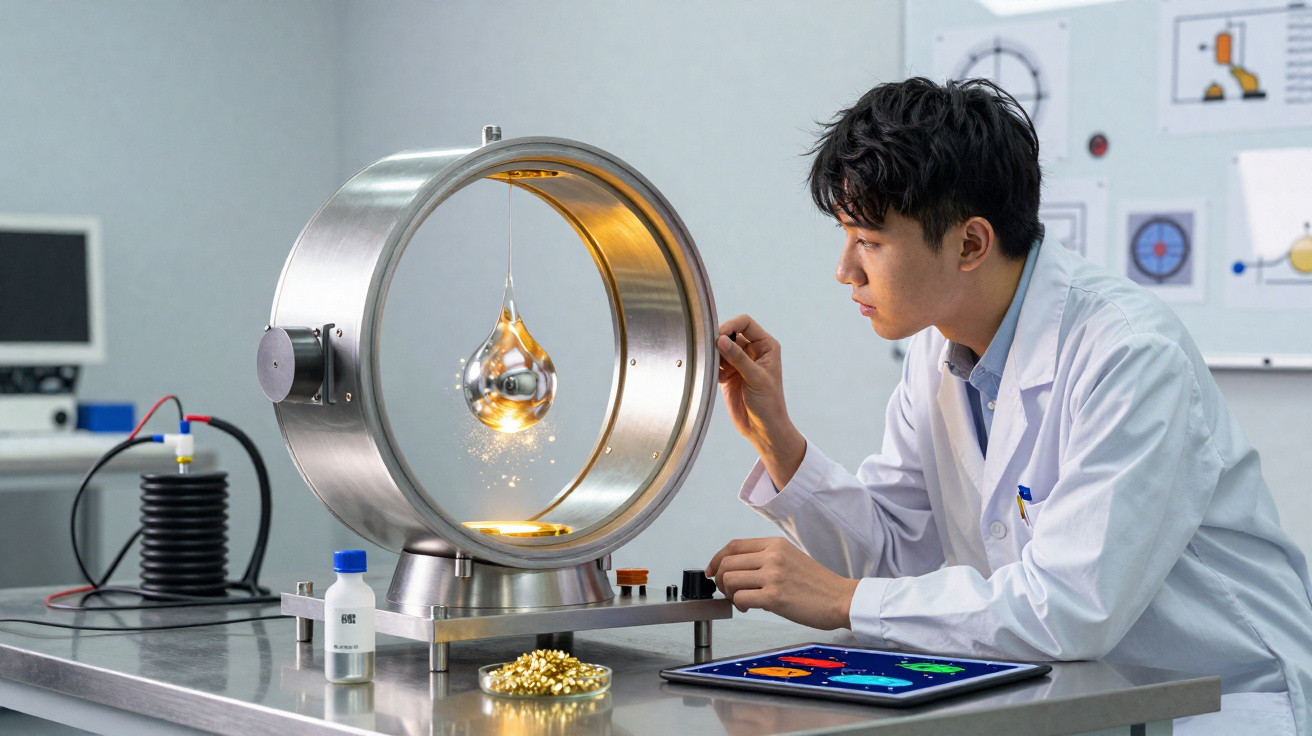
The alchemist’s ambition has always been to turn ordinary metals into gold, but is it actually possible?
The physics behind converting one element into another is well established, and has been applied for decades in accelerators and colliders that crash subatomic particles into one another.
The best-known modern example is Cern’s Large Hadron Collider in Geneva. Yet producing gold in this manner is extraordinarily expensive, while the amount created is tiny.
Cern’s Alice experiment, for instance, calculated that it made just 29 picogrammes of gold during four years of operation. At that pace, creating one troy ounce of gold would require hundreds of times the age of the universe.
Marathon Fusion’s proposal to make gold from mercury
California start-up Marathon Fusion has suggested a markedly different method. It would harness radioactivity from neutrons in a nuclear fusion reactor to convert one type of mercury into mercury-197.
That isotope then decays into gold-197, a stable form of gold. Particle decay is the process in which one subatomic particle spontaneously becomes two or more lighter particles.
Marathon Fusion’s team estimates that a fusion power station could generate several tonnes of gold for every gigawatt of thermal power over a single year of operation.
When the mercury-198 isotope is bombarded with neutrons, it produces radioactive mercury-197, which then decays into gold’s only stable isotope.
The crucial requirement is neutrons energetic enough to set off this mercury-decay chain. If the process can be made to function, it is certainly an intriguing proposal. Whether it could generate a healthy profit, however, is a separate question.
Neutron energy and fusion reactor requirements
Achieving this would require a substantial neutron flux, which measures the intensity of neutron radiation. Such a flux can be produced by using the conventional fusion-reactor fuel combination of deuterium and tritium, both forms of hydrogen, to generate energy within a reactor’s plasma.
Neutrons readily pass through materials and bounce off atomic nuclei, or cores, losing speed in the process. To convert mercury-198 into gold, neutrons must have energies greater than 6 million electron volts.
To produce its forecasts, Marathon Fusion has relied on a fusion reactor’s "digital twin": a computer simulation modelling the physics of the fusion reaction and the radioactive processes it produces. The drawback of this approach is that the digital twin must be checked against an operating commercial fusion reactor, and none exists at present.
Scientists still face numerous obstacles before a commercial fusion reactor can become reality. These include developing new construction materials and understanding the science needed both to run the system while continuously drawing out power and to create AI systems capable of helping to sustain the plasma fusion reaction.
Even highly sophisticated fusion projects, including the UK-based JET (Joint European Torus) experiment, have been able to produce only comparatively modest quantities of energy.
Researchers in the UK have nevertheless developed a way to reduce fusion-reactor size by altering how exhaust plasma is managed. A prototype based on this new reactor design, known as Spherical Tokomak for Energy Production (Step), is intended to be ready by 2040.
Radioactive waste
In principle, mercury can be converted into gold inside a fusion reactor. Until commercial fusion reactors become available, though, the assumptions Marathon Fusion has used in its digital-twin research cannot be tested.
In addition, gold made in a fusion reactor would at first be radioactive. It would therefore count as radioactive waste and would have to be managed for a considerable period after it was produced.
Nuclear and particle physicists are well aware that it is easy to overlook significant physical effects and essential details when building an experiment’s digital twin.
Processing this waste into usable, pure forms of gold would create another problem to solve, although that may not put off investors taking a long-term view.
At present, it is an appealing prospect on paper, but a new form of Californian gold rush remains some distance away.
Adrian Bevan, Professor of Physics, School of Physical and Chemical Sciences, Queen Mary University of London
This article is republished from The Conversation under a Creative Commons licence. Read the original article.




Comments
No comments yet. Be the first to comment!
Leave a Comment