
The sideboard has just been assembled, the doors line up properly, and the spare screws have been put away in that little bag you swear you will not lose. A few months later, though, there is a slight wobble in the frame, a quiet creak when you move the unit to vacuum behind it, or a shelf that feels less secure than it did on day one. We have all had that moment when an IKEA piece of furniture suddenly seems far flimsier than it did in its flat-pack box. The good news is that you do not need a joiner’s workshop or expensive equipment to make a difference. A tube of wood glue, applied in the right places, can dramatically improve how firmly a unit holds together. The outcome is often surprisingly effective.
The assembly detail people often overlook
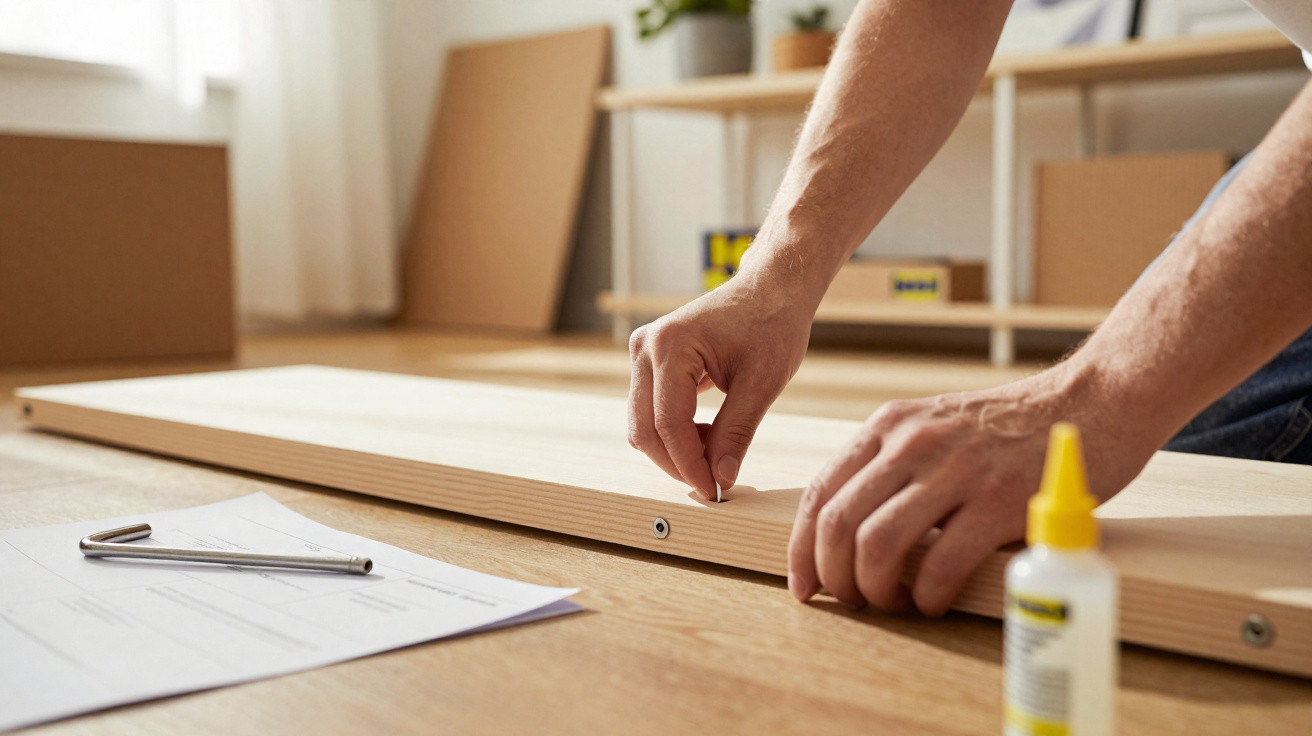
When putting together flat-pack furniture, it is tempting to rush: insert a dowel, tap it with a mallet, turn a cam screw, then move straight on to the next step. It is efficient and almost hypnotic. Yet the weak point in many chipboard units is not necessarily the larger screws, but the small wooden dowels joining the panels. They keep components aligned, spread the load and prevent the frame from shifting out of square. Adding a thin layer of wood glue to these dowels turns them from simple assembly guides into genuine anchor points.
One reader described rescuing a BILLY bookcase that had already survived three house moves. It leaned slightly, its shelves creaked, and they feared it might eventually come apart under the weight of the books. They carefully dismantled it, reapplied PVA glue to every dowel and reinforced the back panel before leaving it to dry overnight. By the following day, the change was obvious: fewer vibrations, a sturdier frame and that reassuring feeling when placing a stack of novels on a shelf. It was almost like having a different piece of furniture.
The claim that it becomes “ten times stronger” should clearly be treated as DIY shorthand rather than a laboratory guarantee. Strength will vary according to the model, the load it carries and the quality of the original assembly. Still, the principle is straightforward: when components rub and move slightly against one another, the holes eventually wear out. Wood glue fills the tiny gaps between the dowel and the panel, then bonds the components together. The furniture moves less and ages more gracefully, provided it is not overloaded like an archive cabinet.
How to reinforce IKEA furniture without changing its character
The most effective approach is to put a small dab of wood glue inside each dowel hole, then spread a light coating over the dowel itself before assembly. There is no need to apply it everywhere: excess glue spills out, marks the edges and makes any future dismantling harder. Push the panels firmly together, wipe away surplus glue immediately with a damp cloth, and follow the drying time stated on the bottle. For large bookcases, chests of drawers and TV units, securing the back panel properly also makes a major difference to overall rigidity. The back panel is not merely decorative: it stabilises the entire structure.
Many people are reluctant to use glue because they assume moving house will then become impossible. That concern is understandable, particularly for renters or people who relocate regularly. The answer is to use it selectively: apply it to the dowels in the load-bearing frame, not to components you may want to alter frequently, such as certain fronts or adjustable shelves. Let us be honest: nobody genuinely dismantles their furniture every day. When a door starts rubbing or a cabinet begins to wobble, the choice between a theoretically removable unit and one that stays stable for years becomes clear.
Before reaching for the glue, check that the panels are clean, dry and properly fitted together. A badly positioned dowel will never be fixed by a tube of glue, however good it may be.
“Good DIY is not about forcing parts to stay together; it is about giving them fewer reasons to move.”
- Choose PVA wood glue intended for indoor use;
- Use only a small amount in each hole, never enough for it to overflow;
- Wipe away drips before they dry;
- Keep the furniture still for the period recommended by the manufacturer;
- Secure tall or narrow units to the wall, especially in a child’s bedroom.
Stronger flat-pack furniture without losing its appeal
This small step also brings a little common sense to the way we view affordable furniture. A reasonable price does not automatically mean a short lifespan; it often simply means giving a unit twenty minutes of care during assembly rather than expecting it to withstand a lifetime of use without attention. A well-assembled shelf can follow you through several homes, work in an office and later a bedroom, or be given new colour or handles. Durability often begins with the details nobody sees. They are not the parts anyone photographs, but they are appreciated every time the furniture stays still.
There is, however, one limitation worth remembering: glue will not turn chipboard into solid oak. If a unit has swollen because of moisture, screws spin freely in their holes or wall fixings are missing, the underlying issue must be addressed. In some cases, discreet brackets, repair dowels or replacing a damaged panel will be more appropriate. But for a newly assembled item, or a sound unit only just starting to show signs of wear, this habit makes a genuine difference. It avoids the frustrating feeling of having bought something “temporary” when it could have lasted.
There is something satisfying about reinforcing a piece of furniture you use every day yourself. It does not make you a joiner, nor is that the aim. You simply learn to see those little holes, wooden dowels and thin back panels differently-the parts that are sometimes nailed on too quickly. Next time an IKEA flat-pack arrives in the living room, keep the tube of wood glue within reach beside the screwdriver. This time, the furniture may have a slightly longer story than expected.
| Key point | Detail | Benefit for the reader |
|---|---|---|
| Glue the dowels | Apply a thin layer of wood glue to the wooden dowels and inside their holes | Reduces play between panels and makes the furniture more rigid |
| Take care with the back panel | Fit the rear panel squarely and secure it without rushing | Reduces distortion and sideways movement |
| Observe the drying time | Leave the furniture untouched for the period stated on the glue | Allows the assembly to gain lasting strength |

Comments
No comments yet. Be the first to comment!
Leave a Comment