
In many homes across the UK, everyday items can undermine the décor without their owners even noticing.
Drawing on an article from the interiors website Home and Garden, several decorators explain how these extremely common items can visually “break up” a room, and why it is worth moving them or incorporating them more effectively. These tips are also relevant to anyone hoping to make their living room, bedroom or hallway feel more harmonious without replacing everything.
When everyday items disrupt a room’s harmony
The experts consulted by Home and Garden are not referring to unusual ornaments or overly bold designer pieces. Instead, they highlight very ordinary possessions that almost everyone owns, but which interfere with the way a room is perceived because they draw attention to the wrong place or create visual clutter.
Some everyday essentials become genuine “mood breakers” when they are badly positioned or left on display.
It is not so much the item itself that causes the issue, but where it sits, its colour, or how it has been left within the space. Decorators often advise moving such items elsewhere, concealing them discreetly, or incorporating them into a more coherent storage arrangement.
The items decorators say visually break up a room
Piles of shoes in the hallway
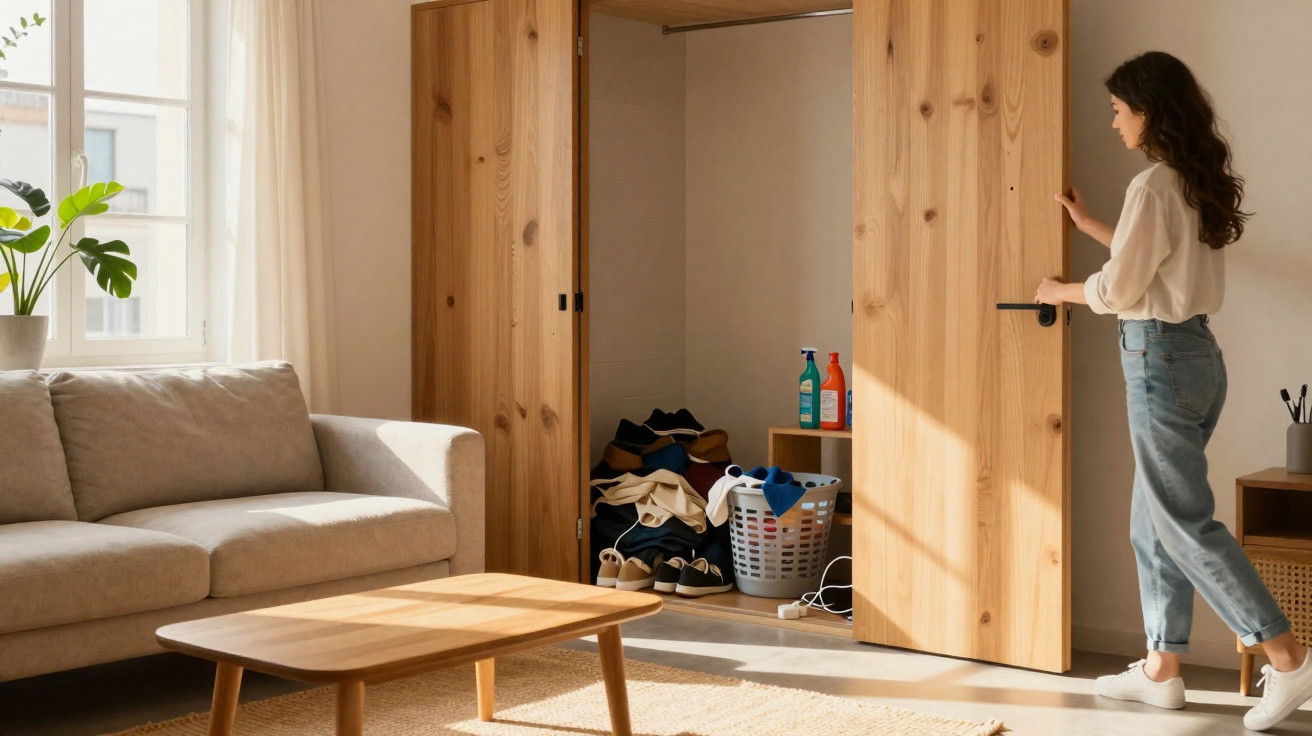
The first familiar culprit identified by decorators is footwear heaped near the front door. Left directly on the floor, shoes create an uneven visual mass that instantly makes the area look untidy.
The specialists interviewed explain that a hallway should instead convey a sense of clarity and easy movement. Seeing a collection of trainers, ankle boots and sandals as soon as the door opens “breaks” that first impression. Decorators advise:
- moving pairs that are not used every day into a closed cupboard or wardrobe;
- keeping only two or three useful pairs by the door, stored in a shoe cabinet;
- leaving as much of the floor clear as possible, so the hallway is not visually “cut up”.
The aim is not to ban shoes from the entrance, but to move away from an informal pile that immediately muddles the room’s appearance.
Visible chargers, extension leads and cables
Another frequently mentioned offender is the cable that winds across the floor or runs up the side of furniture. Phone chargers, white extension leads and black computer power blocks divide up a room and inevitably catch the eye, even subconsciously.
Decorators suggest shifting these items into less prominent places: behind furniture, in a secondary corner, or directly beside a desk rather than in the middle of the living room. Some recommend cable boxes or cable trunking to contain as many of these technical items as possible.
A cable in the wrong place can disrupt the line of a wall, spoil the perspective of a corridor or ruin an otherwise carefully planned reading corner.
The professionals’ key recommendation is to designate a “technical point” in the room rather than allowing wires to appear in several different places.
Laundry baskets left in view
Laundry baskets, even attractive ones, are among the objects considered disruptive when placed in the middle of a bedroom or bathroom. They immediately bring chores to mind while taking up a substantial amount of visual space.
The decorators featured by Home and Garden suggest:
- putting the basket in a cupboard or wardrobe whenever the layout allows;
- positioning it in an unobtrusive corner rather than at the centre of the room;
- avoiding a row of several baskets in a bedroom, which creates a feeling of overcrowding.
Dirty laundry is part of daily life, but it does not need to be on show in spaces intended to feel restful, such as the bedroom.
Cleaning products and cleaning equipment
Brooms, mops, cleaning bottles and window sprays are rarely visually appealing. When left in a kitchen or corridor corner, they visually “break up” the space, even when the rest of the décor is carefully considered.
The decorators quoted by Home and Garden recommend allocating an enclosed area to cleaning supplies: a dedicated cupboard, utility room, pantry or, at the very least, a cabinet in which products can be stored. They also point out that these objects evoke an unappealing practical task, which clashes with the sense of relaxation sought in a living room or bedroom.
Storage baskets and boxes left out permanently
Plastic tubs, fabric baskets and large storage boxes can be useful, but when they remain in the middle of a room all the time, they can make the home feel as though it is permanently being moved into. Even when neatly filled, they visually fragment the space.
Experts recommend treating them as temporary solutions: for sorting, a particular activity, or rotating toys in a child’s bedroom. At other times, they are better kept in a cupboard, beneath a bed or in a secondary room.
A basket placed randomly on the floor or in a corner suggests work still in progress, whereas a finished room should be readable at a glance.
How to move these everyday items without losing practicality
Putting things away elsewhere does not have to make daily routines more difficult. Decorators emphasise one principle: keep useful possessions within easy reach, while arranging their “landing place” in less exposed areas.
For example, they recommend:
- considering the real routes taken around the home - where shoes come off, where phones are charged - and fitting closed storage in those locations;
- using service spaces, such as a utility room, pantry or storage cupboard, for the least decorative items;
- favouring high-level or built-in storage, which clears the view at eye level.
For someone living in a flat without a utility room, this could simply mean a cupboard with doors in the hallway, a storage chest at the end of the bed, or a tall bathroom cabinet. The objective remains unchanged: reduce the number of “technical” items visible at once.
What this means for homes across the UK
The observations shared by Home and Garden apply widely to British homes. In a London flat or a house elsewhere in the country, the same items are often found in the same places: shoes in the hallway, cables around the sofa and a laundry basket in the bedroom.
Interior designers in the UK make the same point: visual flow matters as much as wall colour or the choice of sofa. They stress:
- the need to clear the hallway, which should be treated as a room in its own right;
- the value of planning closed storage instead of accumulating open baskets and boxes;
- the effect of corridors, which can become crowded with coat stands, cartons or small furniture that disrupts the view.
Planning regulations and public grants have no bearing here: these are interior-layout choices made by homeowners or tenants. British equivalents of the Home and Garden decorators, including interior designers and professional organisers, give the same advice in their work.
Why these details have such a strong effect on how a room feels
The items singled out by decorators share one feature: they interrupt a room’s natural lines. A pile of shoes breaks up the floor, a laundry basket placed in the middle of a wall draws the eye, and a bundle of cables crosses a skirting board.
Professionals explain that the eye looks for simple reference points: a clear wall, an uninterrupted floor and a few clearly defined zones. When too many practical items attach themselves to these lines, a room appears smaller and more disorganised, even when it is clean.
By moving just a few awkwardly placed objects, it is sometimes possible to gain as much of a feeling of space as by changing furniture or colour.
For readers in the UK, this advice can take the form of a short, targeted decluttering session: identify the most visible practical item in each room and find it a more discreet home. A simple change of position, with no additional purchase, is often enough to make the overall space feel more coherent.
Conversely, overlooking these room-disrupting items may reduce the impact of costly renovations or purchases. Beautiful paintwork, a new sofa or a quality rug will lose some of their effect if the eye is immediately caught by a misshapen basket, a taut black cable or a stack of shoes by the front door.


Comments
No comments yet. Be the first to comment!
Leave a Comment