
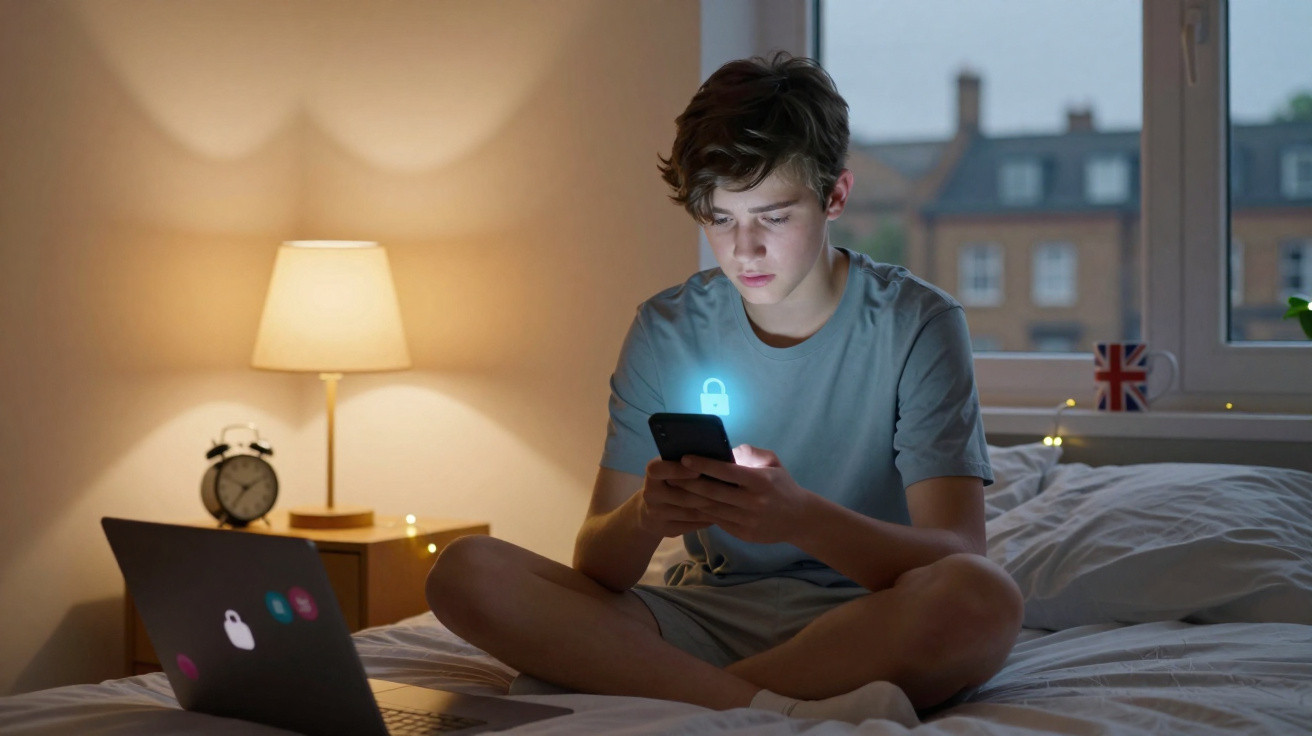
The United Kingdom is preparing an unprecedented measure intended to make 16- and 17-year-olds put down their smartphones at night, and it could well influence neighbouring European countries.
The United Kingdom is continuing to tighten its rules on social media for younger users. Following last month’s announcement of a ban for under-16s, the British government is now targeting 16- and 17-year-olds through a new proposal led by Science, Innovation and Technology Secretary Liz Kendall: a digital curfew.
A digital curfew for 16- and 17-year-olds
In practice, certain apps will be blocked by default from midnight until 6 am. Although teenagers will still be able to turn off the restriction in a few clicks, the setting is primarily designed to encourage them to disconnect overnight. That is not the only planned change. The proposal, which is due to be introduced in Parliament by the end of the year, also targets features that encourage prolonged screen use: autoplaying videos and personalised news feeds will also be disabled by default for this age group.
The aim is to prevent an abrupt transition as young people move from a complete ban before the age of 16 to unrestricted access immediately afterwards.
A study supporting the proposal
The measure was selected following government-commissioned research comparing three forms of restriction: a daily limit of 15 minutes, a night-time curfew running from 9 pm to 7 am, and the outright removal of apps.
The curfew proved to be the easiest option to maintain over time and, above all, the most beneficial for sleep. The young people involved went to bed earlier, felt better rested, and were better able to concentrate in lessons and while revising. Some said they experienced less day-to-day stress, with positive effects building over the weeks. In participating households, mealtimes and family time also regained a meaningful place.
However, the trial was not entirely positive. Several teenagers felt disconnected from their friends, particularly on apps such as Snapchat, where communication is almost continuous. The first few days could be difficult, sometimes bringing irritability and mood swings. Some parents even likened this adjustment period to withdrawal.
A worldwide push to restrict social media
Despite these trade-offs, the British government believes the benefits outweigh the drawbacks. It is far from alone in making that calculation: restrictions aimed at protecting younger people from social media are emerging worldwide.
Australia led the way in December 2025 by banning social media for under-16s. TikTok, Instagram, Snapchat, YouTube and X are among the platforms covered, and the companies are required to verify the age of their users. Those that fail to comply face substantial fines.
European countries consider similar measures
The trend is also gathering pace in Europe, especially in France, where legislation to ban these platforms for under-15s is being refined. Denmark, Spain and Germany are considering comparable steps. It remains to be seen whether such restrictions will genuinely work in practice against teenagers accustomed to bypassing barriers, particularly through VPNs.






Comments
No comments yet. Be the first to comment!
Leave a Comment